The most effective OCD treatment in Nagpur is CBT with Exposure and Response Prevention (ERP) from a trained clinical psychologist. It teaches your brain to face an obsession without performing the ritual. For moderate to severe OCD, a psychiatrist may add an SSRI medicine, and clinical hypnotherapy can lower the anxiety that fuels the cycle. Most people see clear improvement within 12 to 20 weekly sessions. At Dr. Vinod Mune’s clinic near Shatabdi Square you can start in person or online.
You wash your hands again, even though they are clean. You go back to check the gas, the lock, the switch, then check once more. A bad thought pushes into your mind, and you cannot shake it off. Then you wonder: “Am I going mad?” No. You are very likely dealing with obsessive-compulsive disorder, and it is one of the most treatable anxiety-related conditions.
This guide explains OCD treatment in Nagpur in plain language: the signs of OCD, why it keeps coming back, the treatments that actually work (ERP, CBT, hypnotherapy and medicine), what happens in a first session, and how to choose the right specialist. If you only remember one thing, remember this: OCD is not a weakness or a bad habit, and it improves with the right therapy.
In this guide
- What OCD really is
- Common symptoms and types of OCD
- Why OCD keeps you stuck: the cycle
- OCD treatment options that work
- How ERP therapy works, step by step
- Where hypnotherapy fits in
- Medicine for OCD: when it is needed
- What happens in the first session
- How to choose an OCD specialist in Nagpur
- How family can help
- OCD treatment with Dr. Vinod Mune
- FAQs
What OCD Really Is
Obsessive-compulsive disorder (OCD) has two parts. Obsessions are unwanted thoughts, images or urges that keep returning and cause intense anxiety or disgust. Compulsions are the actions or mental rituals you feel forced to do to reduce that distress, such as washing, checking, counting, praying a set number of times or asking for reassurance.
Everyone double-checks the door sometimes. OCD is different because the thoughts feel impossible to ignore, the rituals take more than an hour a day, and life starts to shrink around them. According to the US National Institute of Mental Health, OCD affects people of all ages and often begins in childhood, the teen years or early adulthood. It is not caused by weak willpower, bad parenting or being “too clean”.
Common Symptoms and Types of OCD
OCD does not look the same in everyone. Here are the patterns I see most often in my Nagpur clinic:
It may be time to see a specialist if:
- Rituals or obsessive thoughts take more than one hour a day.
- You are late for work, college or school because of checking or cleaning.
- You avoid places, people or tasks to escape the anxiety.
- Family members are pulled into your rituals or keep giving reassurance.
- You feel ashamed, exhausted or hopeless, or sleep and mood are suffering.
OCD is often confused with general anxiety or depression, and the three can overlap. If you are unsure what you are dealing with, read our guide on anxiety vs depression vs OCD.
Why OCD Keeps You Stuck: The OCD Cycle
OCD survives on a simple loop. An obsession triggers anxiety. You do a compulsion, and the anxiety drops for a few minutes. Your brain then learns, “The ritual saved me,” so the next obsession arrives even stronger. This is why reassurance, willpower and “just stop thinking about it” never work for long.
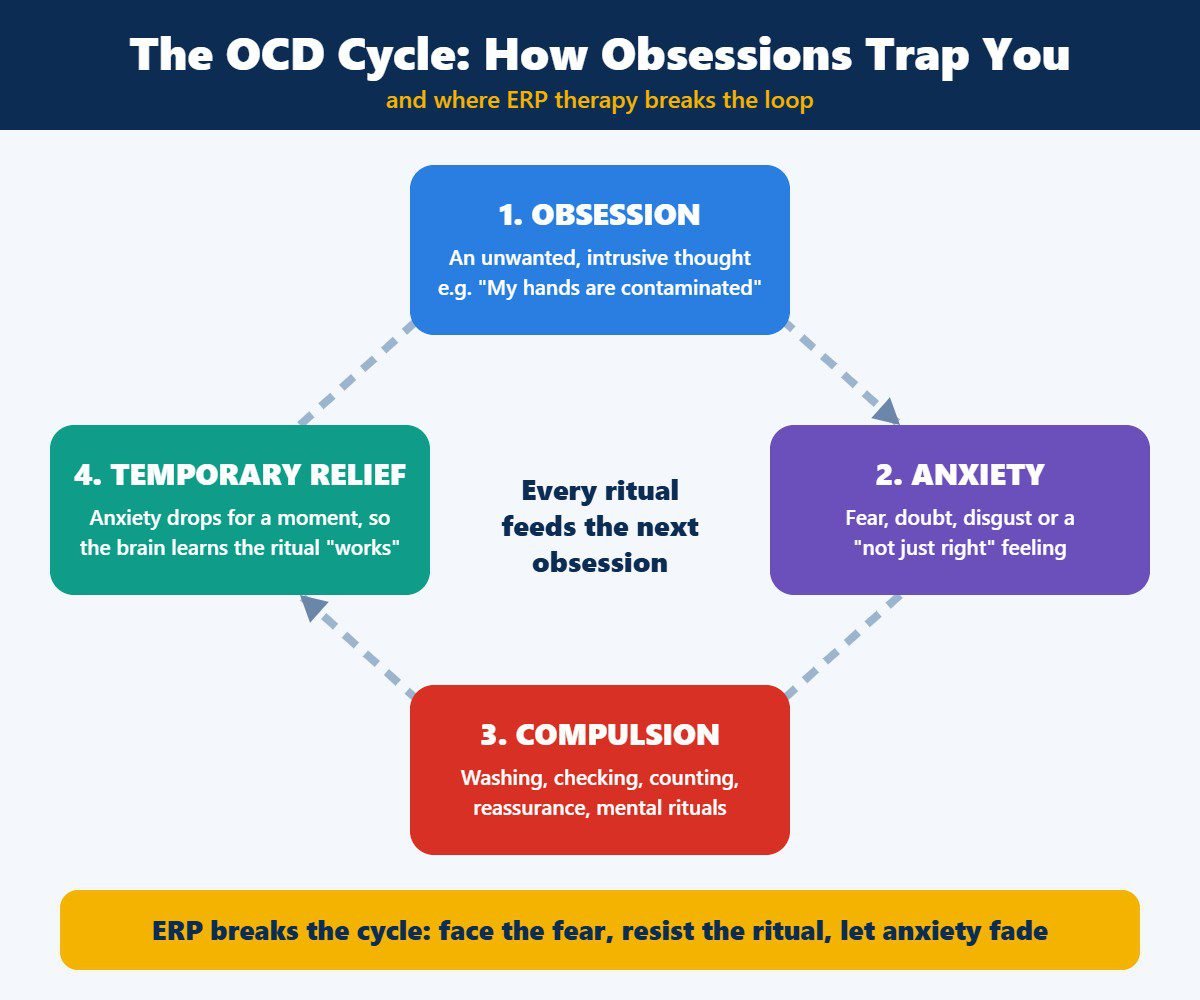
Good OCD treatment works by breaking this loop at the point where it matters: the compulsion.
OCD Treatment Options That Work
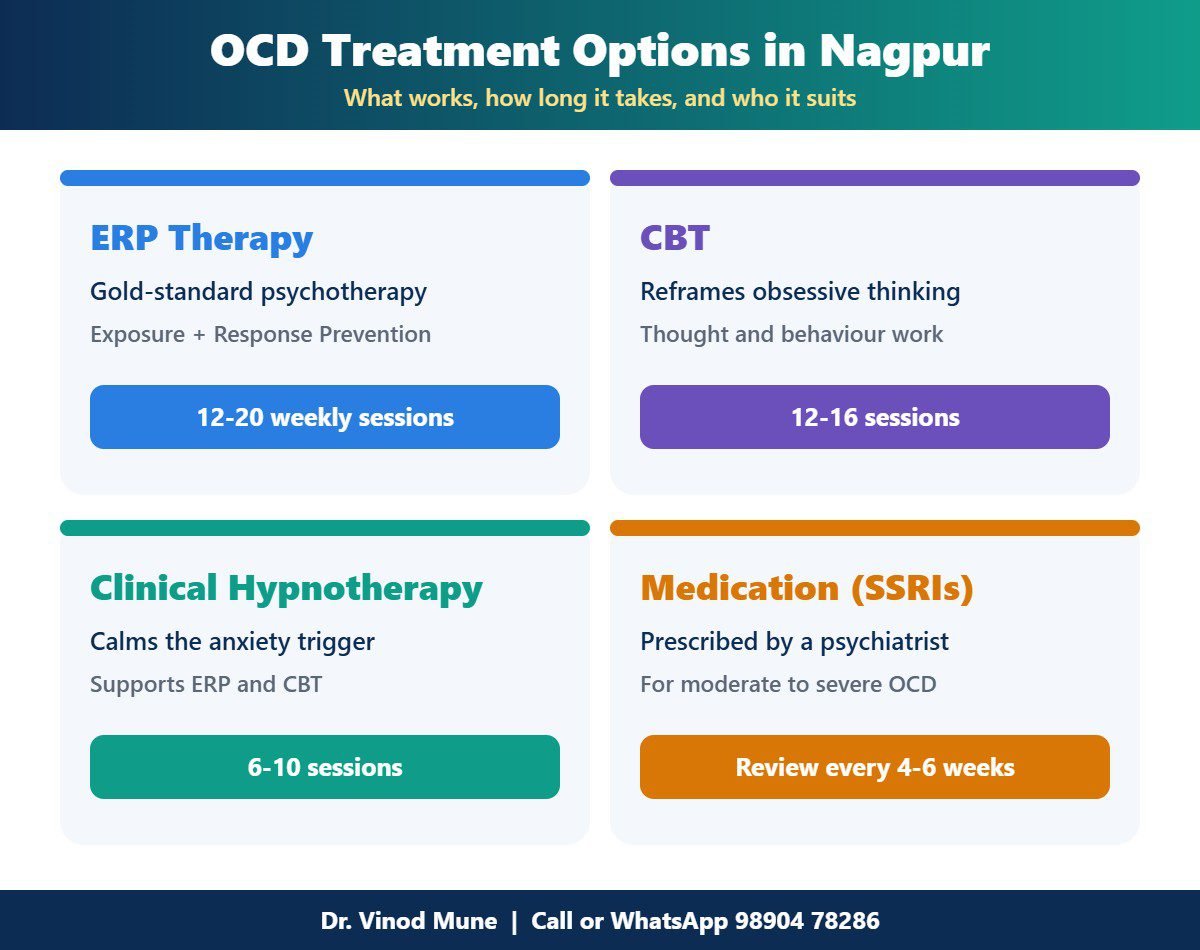
Four approaches are used for OCD. The right plan depends on how severe your symptoms are, how long you have had them and what you prefer.
| Treatment | What it does | Typical duration | Best for |
|---|---|---|---|
| ERP therapy | Gradual exposure to feared triggers while resisting rituals | 12–20 weekly sessions | All severities; the first-line treatment |
| CBT | Changes how you interpret intrusive thoughts and doubts | 12–16 sessions | Thinking-driven OCD, mental rituals |
| Clinical hypnotherapy | Reduces anxiety, stress and sleep problems that feed OCD | 6–10 sessions | As a support alongside ERP and CBT |
| Medication (SSRIs) | Lowers the intensity of obsessions and anxiety | Reviewed every few weeks by a psychiatrist | Moderate to severe OCD, or when therapy alone is not enough |
Importantly, these are not rivals. Many people do best with ERP as the core treatment, plus medicine or hypnotherapy when needed. For a deeper look at our approach, see our page on OCD treatment in Nagpur and the article on OCD counselling in Nagpur.
How ERP Therapy Works, Step by Step
Exposure and Response Prevention is the gold standard for OCD. It sounds scary, but it is done slowly, with your consent, and at your pace. You are never forced into anything.
- Assessment. We map your obsessions, rituals, triggers and what you avoid. A rating scale tracks progress.
- Fear ladder. Together we list triggers from mildly uncomfortable to most difficult and rank them from 0 to 100.
- Exposure. You face one trigger from the lower rungs, for example touching a door handle, in the session and at home.
- Response prevention. You practise not doing the ritual. Anxiety rises, peaks and then falls by itself, and your brain learns the fear was a false alarm.
- Climb the ladder. Each rung gets easier. Confidence grows step by step.
- Relapse prevention. You learn to spot early warning signs, and we plan a few booster sessions.
Learn more about related therapy approaches in our guide to overthinking treatment in Nagpur, since mental rituals and overthinking often go together.
Want to start ERP for OCD?Book a confidential first session with Dr. Vinod Mune in Nagpur or online.
Where Clinical Hypnotherapy Fits In
I want to be clear and honest here: hypnotherapy is not a replacement for ERP. What it does well is calm the body and mind. Many people with OCD live in constant tension, sleep badly and feel panicky before exposure tasks. Relaxation and guided imagery make that anxiety easier to handle, so ERP becomes more comfortable and you stay in treatment. Breathing practice helps too, and you can start today with our guide to breathing exercises for anxiety.
Medicine for OCD: When It Is Needed
Certain antidepressants called SSRIs are used to treat OCD. They usually take 8 to 12 weeks to show their full effect, and OCD often needs higher doses than depression. Only a psychiatrist can prescribe and adjust them. A clinical psychologist does not prescribe medicine, but we work alongside your psychiatrist so therapy and medication support each other.
Important: Never stop or change OCD medicine on your own, even if you feel better. Stopping suddenly can cause withdrawal symptoms and relapse. Talk to your psychiatrist first.
What Happens in the First OCD Session
- A calm, judgment-free conversation. Nothing you share is too strange. Psychologists hear these thoughts often.
- A detailed history of symptoms, triggers, family history, sleep, stress and any medicines.
- A clear diagnosis and an explanation of what OCD is and is not.
- A personal treatment plan with the number of sessions, goals and the first home practice.
- A referral to a psychiatrist if medicine looks necessary.
How to Choose an OCD Specialist in Nagpur
- Do they use ERP-based CBT, and do they explain it clearly?
- Are they a qualified clinical psychologist with real experience treating OCD?
- Do they avoid promising a “100% cure in one session”? Honest clinicians talk about steady progress.
- Do they stop you from seeking reassurance rituals rather than feeding them?
- Do they work with a psychiatrist when medicine is needed?
- Is online therapy available if you cannot travel?
More on this in our 9-point checklist to choose a psychologist in Nagpur.
How Family Can Help (and What to Avoid)
Families often love the person with OCD so much that they join the rituals, answer the same question twenty times or wash things “just to help”. This is called accommodation, and it quietly makes OCD stronger. Instead:
- Respond with kindness, not anger. OCD is not a choice.
- Gently reduce reassurance and ritual help, as agreed with the therapist.
- Praise effort, not just results.
- Join a session if the therapist invites you.
OCD Treatment with Dr. Vinod Mune in Nagpur
Dr. Vinod Mune is a clinical psychologist and master hypnotherapist with more than 15 years of practice. His OCD programme combines ERP, CBT and supportive hypnotherapy, with sessions in his clinic near Shatabdi Square, Nagpur, or online. Read what patients say on the testimonials page, or contact the clinic to book.
Ready to take control of OCD?You do not have to fight it alone. Call or WhatsApp to book a confidential session in Nagpur or online.

Written by Dr. Vinod Mune
Clinical Psychologist & Master Hypnotherapist, Nagpur. MA (Clinical Psychology), MSc (Psychology), with 15+ years of practice and 10,000+ sessions. Dr. Mune treats OCD, anxiety, panic attacks, depression and stress through counselling, CBT, ERP and clinical hypnotherapy. Visit the clinic page.
FAQs: OCD Treatment in Nagpur
What is the best treatment for OCD?
The best-proven treatment for OCD is Cognitive Behavioural Therapy with Exposure and Response Prevention (ERP). Medicines such as SSRIs, prescribed by a psychiatrist, are added for moderate to severe OCD. Clinical hypnotherapy can support therapy by reducing anxiety.
Can OCD be cured completely?
OCD is a long-term condition, but it is highly treatable. Many people reach remission or a level where symptoms no longer control their life. With ERP, most people see clear improvement in 12 to 20 sessions, and a few booster sessions help prevent relapse.
How long does OCD treatment take in Nagpur?
Mild to moderate OCD usually needs 12 to 20 weekly therapy sessions. Severe or long-standing OCD may take longer. Early improvement often appears within the first 4 to 6 sessions.
Is OCD treatment possible without medicine?
Yes, for many people. Mild to moderate OCD often improves with ERP and CBT alone. Medication becomes important when symptoms are severe or when therapy alone is not enough. Never start or stop medicine without your psychiatrist.
Does hypnotherapy work for OCD?
Hypnotherapy is not a stand-alone cure for OCD, but it can reduce anxiety, improve sleep and make exposure work easier. At the clinic it is used together with ERP and CBT, never instead of them.
What is the difference between OCD and normal habits?
Habits save time and cause no distress. OCD thoughts are unwanted and distressing, and rituals take over an hour a day or interfere with work, studies or relationships.
Can I get online OCD treatment from Nagpur?
Yes. ERP and CBT work well over video sessions, so you can attend from your home in Nagpur or from another city. Call or WhatsApp 98904 78286 to book.
Where can I find an OCD specialist near me in Nagpur?
Dr. Vinod Mune, clinical psychologist and hypnotherapist, treats OCD at his clinic near Shatabdi Square, Nagpur, and online. Call or WhatsApp 98904 78286 for a confidential first session.
This article is for general information and awareness only. It is not a diagnosis or a substitute for professional medical advice. OCD should be assessed by a qualified mental health professional. Do not start or stop any medication without your doctor’s guidance. If you are in crisis or having thoughts of self-harm, contact a doctor or your nearest emergency service immediately.