For quick relief, the physiological sigh (two short inhales through the nose, then one long, slow exhale) and long-exhale breathing calm the body within 1–2 minutes. For long-term change, practise belly breathing or resonance breathing (about 6 breaths a minute) for 10 minutes a day. The key is a slow, longer out-breath, which tells your nervous system that you are safe. If anxiety or panic keeps coming back, breathing works best together with therapy from a psychologist.
Your heart is racing. Your chest feels tight. Your thoughts are running in ten directions at once. In that moment, almost everyone gets the same advice: “just take a deep breath.” But if you have tried it, you know that one big gulp of air rarely helps. In fact, it can sometimes make the panic worse.
That is because how you breathe matters far more than how much you breathe. The right breathing exercises for anxiety can calm your body in minutes, while the wrong ones keep the alarm switched on. In this guide, I explain why breathing affects anxiety so strongly, six techniques that actually work, a step-by-step plan for a panic attack, and how to build a simple daily routine. In addition, you will learn when breathing alone is not enough and how to get help in Nagpur.
In this guide
Why Breathing Changes Anxiety So Quickly
Anxiety is your body’s alarm system. When your brain senses danger, real or imagined, it switches on the “fight or flight” response. As a result, your heart beats faster, your muscles tighten and your breathing becomes quick and shallow, high up in the chest.
Here is the important part: breathing is the only part of this alarm system that you can control on purpose. You cannot simply order your heart to slow down. However, you can slow your breath, and when you do, the heart and mind follow.
This works mainly through the out-breath. Every slow exhale activates the vagus nerve, which acts like a brake on the nervous system. That is why breathing exercises for anxiety almost always use an exhale that is as long as, or longer than, the inhale. Research supports this too. For example, a 2023 Stanford study found that just five minutes a day of exhale-focused breathing improved mood and reduced anxiety more than mindfulness meditation alone.
Signs Your Breathing Is Feeding Your Anxiety
Many people with anxiety breathe in a way that quietly keeps the body on alert all day. Check if any of these sound familiar:
- Chest breathing: your chest and shoulders rise more than your belly.
- Frequent sighing or yawning, or a feeling that you “can’t get a full breath.”
- Mouth breathing, especially at night or while working.
- Holding your breath while you concentrate, type or worry.
- Dizziness, tingling hands or a tight chest when stressed, often signs of over-breathing.
- Waking up tired, with a dry mouth or after snoring.
If several of these apply to you, the good news is that breathing is a habit, and habits can be retrained. If you are not sure whether what you feel is anxiety, low mood or something else, read our guide on anxiety vs depression vs OCD.
6 Breathing Exercises for Anxiety That Actually Work
Below are six techniques I teach clients most often. Try each one for a few days, and then keep the two that feel best for you. Importantly, practise them when you are calm first, so your body already knows them when anxiety strikes.
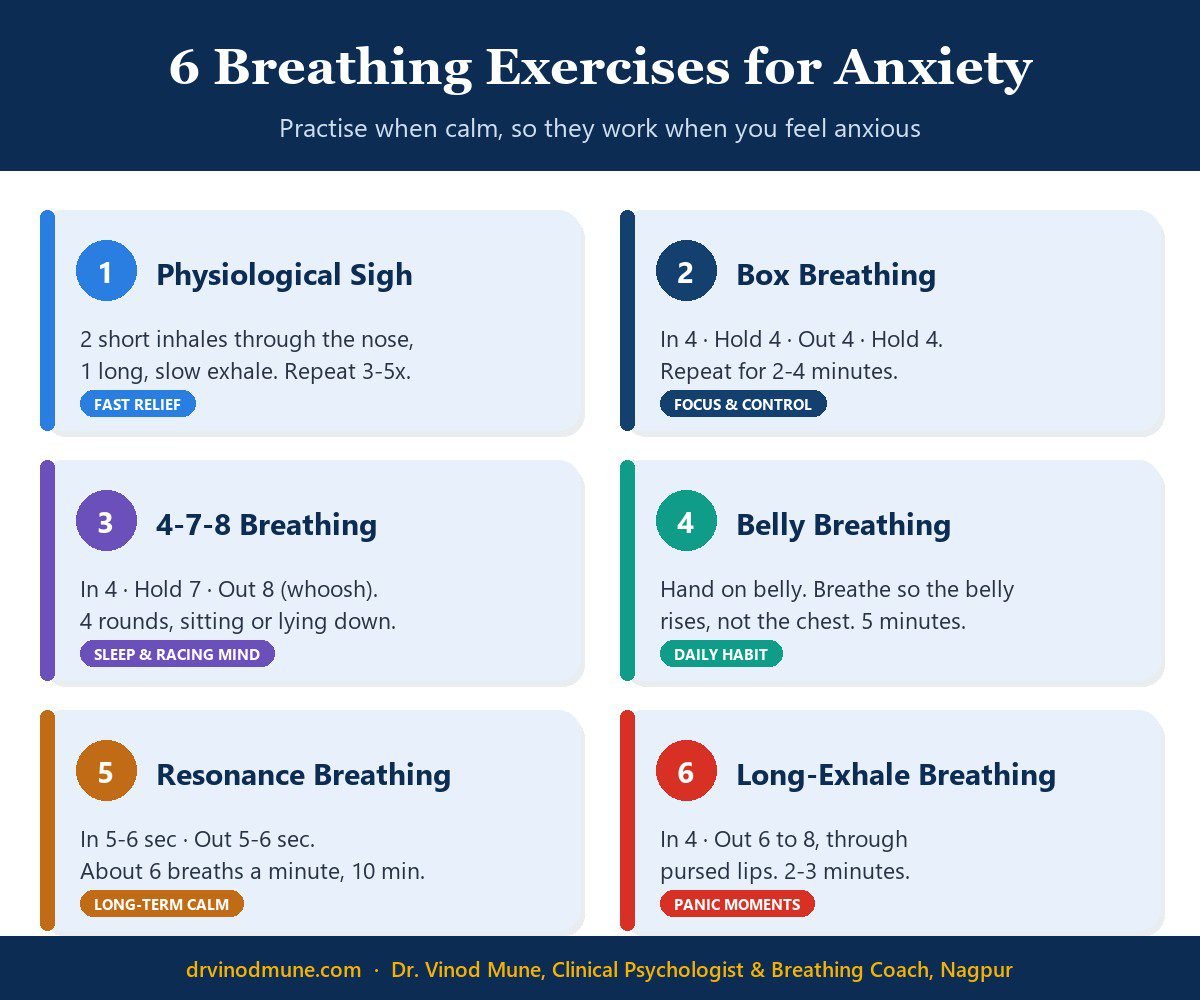
1. The Physiological Sigh (fastest relief)
This is the quickest way to calm down that we know of, and your body already does it naturally when you cry or before you fall asleep.
- Breathe in through your nose until your lungs feel full.
- Without breathing out, take a second short “top-up” sniff through the nose.
- Now breathe out slowly through your mouth until your lungs feel empty.
- Repeat 3 to 5 times. Most people feel calmer after just two or three rounds.
Best for: sudden stress, before a meeting or exam, or the first signs of panic.
2. Box Breathing (for focus and control)
Box breathing is used by athletes and soldiers to stay calm under pressure. Picture tracing the four sides of a square.
- Breathe in through the nose for a count of 4.
- Hold gently for 4.
- Breathe out slowly for 4.
- Hold empty for 4. Repeat for 2 to 4 minutes.
Best for: overthinking, work stress and staying steady before a difficult conversation. If holding the breath makes you uneasy, simply skip the holds.
3. 4-7-8 Breathing (for sleep and a racing mind)
- Breathe in quietly through the nose for 4.
- Hold for 7.
- Breathe out completely through the mouth with a soft “whoosh” for 8.
- Do 4 rounds to start, sitting or lying down.
Best for: falling asleep, night-time worry and calming down after an argument. At first you may feel light-headed, so go slowly and stay seated.
4. Belly (Diaphragmatic) Breathing (the daily foundation)
Most anxious people breathe from the chest. Belly breathing trains your main breathing muscle, the diaphragm, to do the work again.
- Sit or lie down. Place one hand on your chest and one on your belly.
- Breathe in through your nose so that the belly hand rises and the chest hand stays almost still.
- Breathe out slowly through slightly pursed lips and feel the belly fall.
- Continue for 5 minutes, once or twice a day.
Best for: building a calmer “default” breathing pattern over weeks.
5. Resonance (Coherent) Breathing (for long-term calm)
Breathing at about six breaths a minute brings your heart rhythm and breathing into balance, which improves heart rate variability, a marker of how well you handle stress.
- Breathe in smoothly through the nose for about 5 to 6 seconds.
- Breathe out smoothly for about 5 to 6 seconds, with no pauses.
- Keep it gentle and quiet. Practise for 10 minutes a day; a breathing app or timer helps.
Best for: people with ongoing anxiety, high BP from stress, or poor sleep.
6. Long-Exhale Breathing (for panic moments)
- Breathe in through the nose for 4.
- Breathe out through pursed lips, as if blowing through a straw, for 6 to 8.
- Repeat for 2 to 3 minutes, keeping the in-breath small and soft.
Best for: panic attacks, breathlessness and a pounding heart, because it slows over-breathing without needing any breath holds.
Want to learn these techniques live, step by step?Join Dr. Vinod Mune’s live Breath Healing Workshop on Zoom, or book a private session in Nagpur.
Which Breathing Exercise Should You Use, and When?
| Situation | Best technique | How long | Why it helps |
|---|---|---|---|
| Sudden stress | Physiological sigh | 3–5 breaths | Fastest way to release tension and slow the heart |
| Panic attack | Long-exhale breathing | 2–3 minutes | Stops over-breathing without breath holds |
| Overthinking at work | Box breathing | 2–4 minutes | Gives the mind a simple task and steadies focus |
| Can’t fall asleep | 4-7-8 breathing | 4–8 rounds | Long exhale shifts the body into rest mode |
| Ongoing anxiety | Resonance breathing | 10 minutes daily | Builds stress resilience over weeks |
| Chest breathing habit | Belly breathing | 5 minutes, twice daily | Retrains a calmer default breathing pattern |
What to Do During a Panic Attack: A Step-by-Step Plan
A panic attack feels terrifying, but it is not dangerous, and it always passes, usually within 10 to 20 minutes. During an attack, people tend to gulp air, which lowers carbon dioxide in the blood and causes dizziness and tingling. Consequently, the goal is to breathe less and slower, not more.
- Name it: tell yourself, “This is a panic attack. It is uncomfortable, but it will pass.”
- Sit down and drop your shoulders. Place a hand on your belly.
- Do 2 or 3 physiological sighs to release the first wave of tension.
- Switch to long-exhale breathing: in for 4 through the nose, out for 6 to 8 through pursed lips.
- Ground yourself: name 5 things you can see, 4 you can touch and 3 you can hear.
- Let the wave pass without fighting it. Fighting the feeling usually makes it stronger.
Important: chest pain, breathlessness and a racing heart can also be signs of a heart or lung problem. If this is your first such episode, if you have a heart condition, or if the symptoms feel different from your usual anxiety, get medical help right away by calling 112.
A Simple 10-Minute Daily Breathing Routine for Anxiety
Breathing exercises work best as a daily habit, not only as an emergency tool. In other words, think of them like brushing your teeth for the nervous system. Here is a routine that most of my clients can follow easily:
Most people notice they feel calmer within a week. Over 4 to 6 weeks, the slower breathing pattern often starts to happen on its own. For more on how breathing helps everyday stress, read our article on the breathing coach in Nagpur for stress relief.
Common Breathing Mistakes That Make Anxiety Worse
- Taking huge deep breaths: big gulps of air can trigger dizziness. Instead, breathe slowly and gently.
- Making the inhale longer than the exhale: this wakes the body up. For calm, the out-breath should be longer.
- Trying it for the first time during panic: practise when calm, so the skill is ready when you need it.
- Forcing long breath holds: if holds make you uneasy, skip them; long-exhale breathing works without them.
- Giving up after two days: the real benefits come from daily practice over several weeks.
- Using breathing to avoid every feeling: breathing should help you face anxiety, not run from it.
When Breathing Exercises Are Not Enough
Breathing exercises are powerful, but they treat the alarm, not always the reason the alarm keeps ringing. For many people, anxiety is held in place by old fears, past experiences and thinking patterns stored in the subconscious mind. That is why some people practise breathing for months, yet the panic still returns.
In my practice, I combine breathing training with therapy so that both the body and the mind change together:
Please consider seeing a psychologist if:
- Anxiety or panic attacks happen often, or you live in fear of the next one.
- You avoid places, travel, people or work because of anxiety.
- Worry affects your sleep, studies, job or relationships for more than two weeks.
- You also feel low, hopeless or stuck in repeated thoughts or checking.
Help for Anxiety and Panic Attacks in Nagpur
Dr. Vinod Mune is a clinical psychologist, master hypnotherapist and breathing coach based in Nagpur. Over 15+ years and 10,000+ sessions, he has helped people overcome anxiety, panic attacks, stress, sleep problems and breathlessness, using a mix of counselling, CBT, clinical hypnotherapy and guided breathwork.
- Mind and body together: therapy for your thoughts plus breathing training for your nervous system.
- Live breath healing workshops: learn and practise the techniques in a guided group on Zoom.
- Complete privacy: a safe, non-judgemental space with strict confidentiality.
- Flexible options: clinic visits near Shatabdi Square, or online sessions from anywhere.
Learn more on our psychologist for anxiety in Nagpur page, read about mental health counselling in Nagpur, or see client testimonials. When you are ready, contact the clinic here.
If you need help right now
If you or someone you know is in crisis or thinking about self-harm, please do not wait for an appointment. Call 14416 (free, 24×7 Tele-MANAS helpline) or 112 for emergencies, and go to the nearest hospital.

Written by Dr. Vinod Mune
Clinical Psychologist, Master Hypnotherapist & Breathing Coach, Nagpur. MA (Clinical Psychology), MSc (Psychology), with 15+ years of practice and 10,000+ sessions. Dr. Mune helps people with anxiety, panic attacks, stress and sleep problems through counselling, CBT, clinical hypnotherapy and breathwork. Visit the clinic page.
FAQs: Breathing Exercises for Anxiety
Which breathing exercise is best for anxiety?
For quick relief, the physiological sigh and long-exhale breathing work fastest. For long-term calm, practise belly breathing or resonance breathing (about 6 breaths a minute) for 10 minutes every day.
How quickly do breathing exercises reduce anxiety?
Many people feel calmer within 1 to 3 minutes of slow, exhale-focused breathing. With daily practice, most notice less overall anxiety within 2 to 6 weeks.
Can breathing exercises stop a panic attack?
They can shorten a panic attack and make it feel less intense. Slow long-exhale breathing stops over-breathing, which causes much of the dizziness and tingling. If panic attacks are frequent, therapy with a psychologist is recommended.
Is the 4-7-8 breathing technique good for anxiety?
Yes. 4-7-8 breathing is especially helpful at night for a racing mind and trouble falling asleep. Start with 4 rounds while sitting or lying down, and skip the hold if it makes you uneasy.
How many times a day should I do breathing exercises?
Aim for about 10 minutes a day in total, for example 5 minutes in the morning and a few minutes at night, plus a few physiological sighs whenever you feel stress rising.
Are breathing exercises safe for everyone?
Gentle breathing exercises are safe for most people. If you are pregnant or have a heart, lung or blood pressure condition, avoid long breath holds and check with your doctor first.
Can breathing exercises replace anxiety treatment?
Breathing exercises are a powerful self-help tool, but they work best alongside therapy when anxiety is frequent or affects daily life. Do not stop any medication without your doctor’s advice.
Where can I get help for anxiety and panic attacks in Nagpur?
Dr. Vinod Mune, clinical psychologist and breathing coach, offers anxiety therapy, clinical hypnotherapy and breathing training at his clinic near Shatabdi Square in Nagpur and online. Call or WhatsApp 98904 78286 to book.
Ready to breathe easier?Book a confidential session with Dr. Vinod Mune for anxiety and panic attacks in Nagpur or online.
This article is for general information and awareness only. It is not a diagnosis or a substitute for professional medical advice. Breathing exercises are generally safe, but if you are pregnant or have a heart, lung or blood pressure condition, check with your doctor first. Do not start or stop any medication without your doctor’s guidance.